Most car owners don’t think about structural welding until something goes visibly wrong — an MOT failure, a strange noise, or a panel that suddenly doesn’t line up the way it used to. But structural damage rarely appears overnight. It usually builds quietly for months, sometimes years, before it becomes obvious enough to notice. By the time the signs are undeniable, the repair is often bigger — and more expensive — than it needed to be.
At MJ Welding & Fabrication in Lye, Stourbridge, we inspect vehicles with structural welding issues every single week, and in almost every case, there were warning signs long before the car ended up on our ramp. In this guide, we’re covering the seven most common signs that your car needs structural welding repair right now, what causes each one, what we do to fix it, and why acting early nearly always saves you money.
What Is Structural Welding, and Why Does It Matter?
Structural welding refers to repairs on the load-bearing parts of a vehicle — the sills, chassis rails, floor pans, subframes, and mounting points that hold the car together and keep it safe in everyday driving and in a collision. Unlike cosmetic bodywork, structural welding directly affects how safely your car performs on the road, which is why MOT testers scrutinise these areas so closely.
You can read more about what this kind of repair involves on our structural welding service page and our detailed guide to professional structural welding. If your car has already been flagged for a structural issue, our page on car welding and structural repair explains what the process typically involves from inspection through to completion.
7 Signs Your Car Needs Structural Welding Repair Right Now
1. Visible Rust or Corrosion on Sills, Arches or the Chassis
This is the most common sign we see, and by far the most common cause of MOT failures. Surface rust that looks minor from the outside often extends much further underneath, particularly around the sills, wheel arches, and chassis rails. If you can see rust bubbling through paint, flaking metal, or actual holes in these areas, structural welding repair is very likely already needed. Our guide on why cars fail their MOT on corrosion explains exactly what testers are looking for in these areas.
2. Your Car Failed Its MOT on Structural Grounds
If your MOT certificate mentions “excessive corrosion,” “structural weakness,” or points to a specific area like the sills, chassis, or seatbelt mounting points, this isn’t optional maintenance — it’s a legal requirement before the car can be driven again. Our page on car failed MOT on corrosion and our dedicated guide to MOT failure welding repairs both cover what these failures mean and how quickly they can typically be resolved.
3. Unusual Noises, Knocking or Rattling While Driving
Clunks, knocks, or rattling noises — particularly over bumps or during turns — can indicate a cracked or weakened mounting point, subframe, or chassis section. These noises are easy to dismiss as “just an old car,” but they’re often an early sign of structural fatigue that will only get worse with continued driving.
4. Doors, Bonnet or Boot Don’t Align Properly
If doors, the bonnet, or the boot lid have started sitting unevenly, are harder to close, or show new panel gaps that weren’t there before, this can be a sign that the underlying structure has shifted or weakened — sometimes from corrosion, sometimes from a previous impact that wasn’t properly repaired. Our car body panel replacement service covers this kind of misalignment issue in more detail.
5. The Vehicle Pulls to One Side or Handling Feels Off
Structural damage doesn’t always show up where you can see it. A weakened subframe or chassis rail can throw off wheel alignment and suspension geometry, causing the car to pull to one side, feel unstable at speed, or handle noticeably differently than it used to. If this has developed gradually, it’s worth having the underlying structure checked, not just the tyres and suspension.
6. Visible Cracks or Flaking Around Seatbelt Mounting Points
This is one of the most safety-critical signs on this list. Seatbelt mounting points are structural by design — they need to withstand enormous force in a collision. Any visible cracking, corrosion, or flaking around these areas should be treated as urgent, not something to monitor over time.
7. Water Leaks or Damp Smell Inside the Cabin
Water ingress through the floor pan, sills, or boot floor is often a direct sign of corrosion that’s already penetrated through the metal. A damp smell, wet carpets, or condensation inside the cabin that wasn’t there before usually means there’s a structural gap somewhere letting water through — and where water gets in, corrosion accelerates. Our guide on 10 hidden signs your car needs welding covers several more subtle warning signs like this one.
Why Ignoring These Structural Welding Warning Signs Is Risky
Structural issues very rarely stay the same size. Rust spreads. Cracks extend under continued stress and vibration. A small, affordable patch repair left unaddressed for six months can turn into a full sill or chassis section replacement. Beyond cost, there’s a genuine safety dimension too — structural components are engineered to protect occupants in a collision, and a weakened chassis or corroded mounting point compromises that protection regardless of how the car otherwise drives day to day. The official government MOT inspection manual sets out exactly why structural corrosion and damage are treated so seriously during testing.
How We Solve Structural Welding Problems
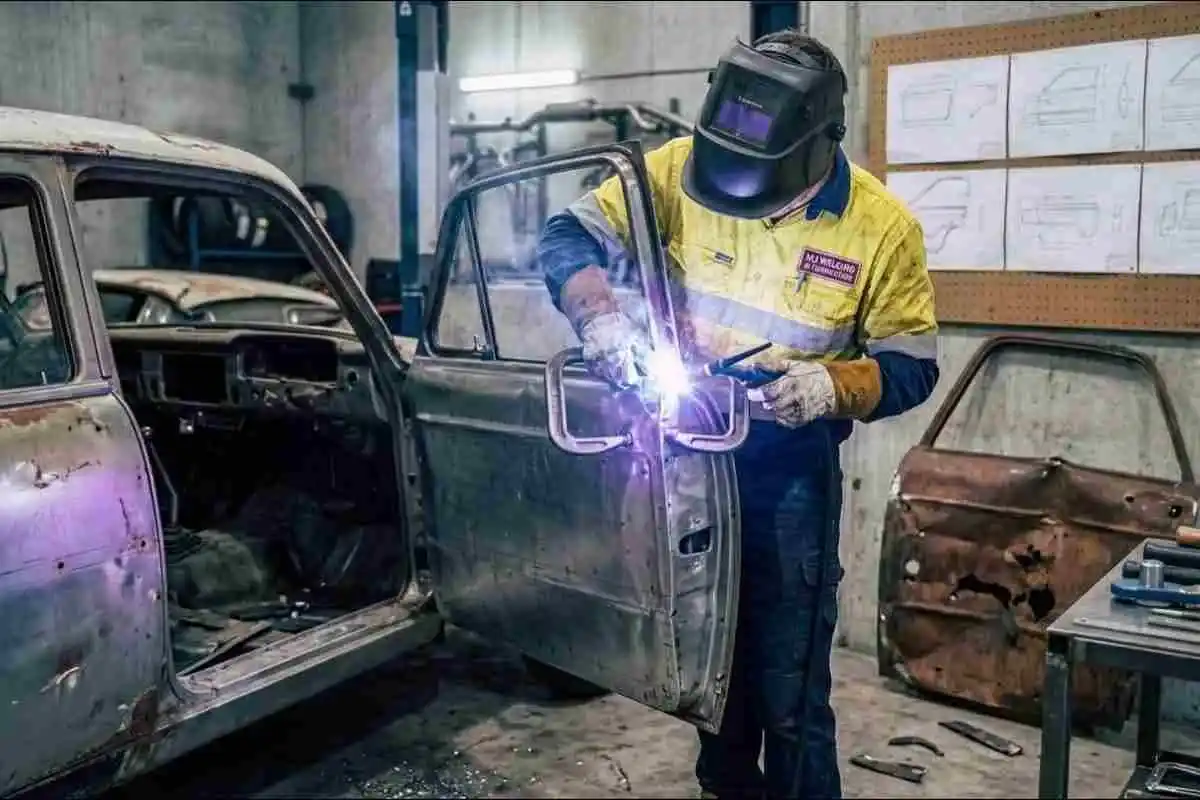
Every structural repair at MJ Welding & Fabrication starts with a proper physical inspection — not a guess based on a phone description. Once we’ve identified the extent of the damage, we use the correct process for the material involved. For standard steel structural sections — sills, chassis rails, floor pans — we use MIG welding, covered in detail on our chassis repair service page and our sills and arch welding service. For vehicles with aluminium structural components, we use TIG welding — our guide on professional aluminium chassis repair covers this in more depth, and if you’re not sure which process your car needs, our comparison guide on aluminium vs steel welding and TIG vs MIG welding for cars both explain the difference in plain terms.
Corroded sections are cut back to clean, solid metal, new steel or aluminium is fabricated and welded into place, and the repair is finished so it’s ready for underseal, primer, or paint depending on the location. Nothing is patched over rust — every repair replaces the affected structural section properly.
DIY vs Professional Structural Repair: Why It Matters
It can be tempting to consider a DIY fix for a small crack or a patch of surface rust, especially with home welding kits widely available. But structural welding is not the place to cut corners. An MOT tester will fail a poorly executed weld just as quickly as untreated corrosion, and a repair that isn’t strong enough can genuinely compromise passenger safety in a collision. What looks like a saving upfront very often turns into a repeat cost once the repair fails inspection or needs to be redone properly.
What Happens If You Delay Structural Welding Repairs?
Delaying structural repairs almost always makes them more expensive. Corrosion doesn’t stay contained — it spreads to adjoining panels and sections, meaning a repair that could have been a localised patch becomes a full section replacement. It can also affect your vehicle’s resale value, since a documented structural repair history (or worse, an undisclosed one) is something buyers and dealers check for closely. Most importantly, driving with known structural weaknesses puts you and your passengers at greater risk in the event of a collision.
Areas We Cover for Structural Welding Repairs
We carry out structural welding repairs for customers across Stourbridge and the wider West Midlands. You can see our full coverage on our service areas page, which includes Birmingham, Dudley, Halesowen, Wolverhampton, Solihull, Kingswinford, Walsall, and many surrounding towns and villages. For a full list of everywhere we cover, visit our car welding near Stourbridge and West Midlands locations pages.
More Guides From MJ Welding & Fabrication
If you found this guide useful, these related articles cover other aspects of car welding and structural repair in more detail:
- How Much Does Car Welding Cost in Stourbridge? (2026 Price Guide)
- TIG vs MIG Welding for Cars: Which One Do You Actually Need?
- Aluminium vs Steel Welding: Key Differences Every Car Owner Should Know
- The 5 Most Common Car Welding Repairs
- 10 Hidden Signs Your Car Needs Welding
- How to Choose the Right Car Welder
- Pre-MOT Structural Rust Checklist
- The Complete Guide to Automobile Welding
- Why Car Owners Trust MJ Welding
- Why West Midlands Drivers Trust MJ Welding
About MJ Welding & Fabrication
MJ Welding & Fabrication is a specialist automotive welding and fabrication workshop based at Bromley St, Lye, Stourbridge, DY9 8HU. With over 15 years of experience, we focus exclusively on welding and fabrication — not general repairs — which means every structural, MOT, or corrosion job gets our full attention and expertise. We work on all makes and models, from everyday hatchbacks to premium 4x4s, vans, and camper van conversions, using professional MIG, TIG, and ARC welding equipment throughout. You can read more on our About Us page, see our full range of services, or browse our complete car welding guide for Stourbridge.
Frequently Asked Questions
How urgent is structural welding repair?
It depends on the severity, but structural issues should never be left indefinitely. If your car has failed its MOT on structural grounds, it’s not legally roadworthy until repaired. Even without an MOT failure, visible corrosion or cracking around load-bearing areas should be assessed promptly.
Can I still drive my car if it needs structural welding?
If your MOT has flagged a structural failure, no — the vehicle is not legally roadworthy. If the issue hasn’t been formally assessed yet, it’s best to get an inspection before continuing to drive, particularly if you’ve noticed handling changes or unusual noises.
How much does structural welding repair cost?
This varies significantly depending on the extent of the damage — from a small patch repair to a full sill or chassis replacement. Our 2026 car welding price guide breaks down typical costs for different types of structural repairs.
How long does a structural welding repair take?
Small repairs can often be completed within a day. Larger structural jobs, such as full sill or chassis section replacement, typically take one to three days depending on parts and the extent of the damage.
Will structural welding repair affect my car’s value?
A properly documented, professionally completed structural repair generally has minimal impact on resale value. What affects value far more is an undisclosed or poorly executed repair, which is why choosing an experienced specialist matters.
Do you offer structural welding repairs for all vehicle makes?
Yes, we work on all makes and models, including vehicles with mixed steel and aluminium structures, vans, and camper van conversions.
Book a Structural Welding Inspection in Stourbridge Today
If any of these seven signs sound familiar, don’t wait for the problem to get bigger. Contact MJ Welding & Fabrication today for an honest structural inspection and a clear, upfront quote.
📞 Call: +44 7532 794934 📍 Bromley St, Lye, Stourbridge DY9 8HU

3 Responses